Thursday, February 02, 2012

Hovercraft Test Covers


Royal Navy Wildcat First Sea Landng


On 7 November 2011,Lieutenant Commanders Robert Dowdell and Lee Evans ,landed the Wildcat on the flight deck of the Royal Fleet Auxiliary (RFA) aviation trials ship Argus off England's south coast. This was the first ship at sea landing of the Wildcat.It was the start of four weeks of tough trials for air and ground crew

Thursday, January 19, 2012

Enrico Scarabotto


The first Italian-built production Eurofighter, IT001, made its maiden flight from Alenia Aeronautica/Caselle on February 14th 2003 at 13:30 GMT. The flight lasted 50 minutes. At the controls were Cpt. Marco Venanzetti, Alenia Aeronautica Test Pilot and Cpt. Enrico Scarabotto, Alenia Aeronautica Test Pilot

Maurizio Cheli 1959-


After graduation from the Italian Air Force Academy, Cheli underwent pilot training at Vance Air Force Base, Oklahoma, in 1982-1983. Following fighter lead-in training at Holloman Air Force Base, New Mexico and initial training in the F-104G in Italy, he joined the 28th Squadron, 3rd Recce Wing in 1984. In 1987, he attended the Italian Air Force War College and in 1988 he graduated from the Empire Test Pilot's School, Boscombe Down, United Kingdom. While assigned to the Italian Air Force Flight Test Center in Pratica di Mare, Rome, he served as a Tornado and B-707 Tanker project pilot on a variety of test programs and as display pilot. His flight experience includes more than 3000 flying hours in over 50 different types of fixed wing aircraft and helicopters. In June 1992, he was selected by the European Space Agency as a member of the second group of European astronauts.


Cheli reported to the Johnson Space Center in August 1992 and completed one year of training in August 1993. He is qualified for assignment as a mission specialist on future Space Shuttle flight crews. His technical assignments to date include: flight software verification in the Shuttle Avionics Integration Laboratory (SAIL); remote manipulator system/robotics; crew equipment. He flew on STS-75 in 1996 and has logged over 377 hours in space.

Agostino Frediani


Marco Venanzetti 1962-


Marco Venanzetti was born in Rome, Italy on 31 August 1962.He joined the Italian Air Force (ItAF) in September 1982. He attended the Italian Air Force Academy from which he graduated in March 1986.In March 1986 he joined the Undergraduate Pilot Training at Sheppard Air Force Base, Texas,USA and graduated in June 1987.
He was then assigned to the Operational Conversion Unit at Grosseto Air Force Base, Italy, flying the TF-104 and after the completion of the course he joined the 9th Fighter Interceptor Squadron flying the F-104S Starfighter.
After four years of operational flying, Marco was selected from the Italian Air Force Flight Test enter and, on May 1992, was assigned to the US Air Force Test Pilot School at Edwards AFB,California, from where he graduated Experimental Test Pilot in June 1993. Returning to Italy, Marco was assigned to the Eurofighter Test Team of the Italian Air Force where he worked till September 1997 participating at various Working Groups. He flew the Eurofighter as military Test Pilot twice (October 1996 and April 1997).In September 1997 Marco was recalled to the operational world as Squadron Commander of the 101st Operational Conversion Unit flying the AMX and AMX-T. During this period he participated to the Bosnia campaign flying the AMX in the Close Air Support role. Marco left the active service in September 1998 to join Alenia Aeronautica as Experimental Test Pilot where, beside the Eurofighter, he was involved in all Company fighter programs like TORNADO and AMX. In November 2006 he was appointed Chief Test Pilot and since December 2008 is the Director of Flight Operations.Marco has flown more than 4500 hours and has been pilot in command in 76 different aircraft and helicopters.

Gianluca Evangelisti


Gianluca Evangelisti was born and raised in Florence, Italy, Gianluca received a Master’s degree in Aeronautical Engineering from the Italian Military Air Force Academy in 1967.He entered the Italian Air Force as a fighter pilot and in 1974 graduated from the United Kingdom’s Empire Test Pilot School. After a successful nineteen year career with the Italian Air Force, Gianluca continued flying as a test pilot for Alenia Aeronautica until 2006.
Gianluca accumulated more than 16,000 hours as a test pilot and has been involved in the test and evaluation of large, medium, tactical, and training aircraft. Programs that he has been involved in include the Boeing 707 Tanker; G222, C-27A and C-27J Medium Transport Aircraft Programs; the Tornado GR4 Ground Attack Aircraft; and the successful MB-339A Advanced Jet Trainer Program.
Mr. Evangelisti oversees all business development activities in Alenia North America and continues to fly for Alenia Aeronautica as a flight instructor for the C-27J. He maintains flight proficiency in the Eurofighter and Ameracchi’s M346 Advanced Jet Trainer.

Sunday, January 15, 2012

Jack A. Bade 1920-1963


Jack A. Bade was born on October 9, 1920, in Minneapolis, Minnesota. He was the only child of Charles and Gladys Bade. He moved to Elk River, Minnesota when his father accepted a job with a bank there.He attended Elk River High School where he played both football and basketball. He graduated in 1938 and attended the University of Minnesota for one and one-half years before accepting employment with Minneapolis Honeywell.He enlisted in January 1942 and volunteered for the Aviation Cadet program. He completed the course and graduated on June 25, 1942 at Luke Field, Arizona. He received both his pilots wings and a commission as a 2nd Lieutenant. He was then assigned to advanced combat training in the P-40 aircraft.In December 1942, he was assigned to the 44th Fighter Squadron of the 18th Fighter Group, flying out of Munda in the Solomon Islands. He flew 85 missions, a total of 210 combat hours against the Japanese forces. During this time, he was credited with 5 aerial victories plus one probable.But his biggest achievement came on February 13, 1943. While escorting a flight of Navy bombers, his unit was attacked by a large force of enemy aircraft. In the ensuing fight, Bade's aircraft was severely damaged, rendering his guns useless. He was severely wounded from a head wound, but saw the Navy bombers under attack by a large force of enemy fighters. He dove straight into the melee, penetrating the enemy formation although his guns were jammed and succeeded in scattering the attackers, and allowing the Navy bombers to escape. For this action, he was awarded the Distinguished Service Cross as well as the Purple Heart.The exploits of Captain Bade (later Major) were used in comic strips and books such as "True Comics" and "Heroic Comics." He also appeared in a cameo role in the 1943 movie "Thunderbirds." In 1956, he appeared in an ad for Camel cigarettes, and in 1962, he was featured in an ad for Chase Manhattan Bank.In late 1943, Bade was assigned by the Air Corps to Republic Aviation where he acted as chief inspector on the emerging P-47 program. After being discharged in 1946, he returned to Republic and eventually became a test pilot, serving in many on-going test programs. Unfortunately, he was killed on May 2, 1963 in a mid-air collision with test pilot Don Seaver, both flying F-105 aircraft at Mach 2, over the Catskill Mountains in New York.Jack A. Bade is buried in Long Island National Cemetery in Farmington, New York.

Saturday, January 14, 2012

Ian Edward MacTavish 1916-1971


Ian Edward MacTavish was born in Ontario in 1916. He enlisted in the RCAF at London, Ontario on 25 June 1940. He trained at No.1 ITS. He was sent England and was a posted to No 410 Sqn RCAF. He flew twin engine Mosquito’s as a night fighter, low level bombing and photo reconnaissance. He flew support for D-day and The Battle of The Bulge. He was credited with three kills, a FW.190 destroyed (1/2 September 1944), Ju.87 destroyed (24/25 December 1944), and a Ju.88G destroyed (24/25 March 1945). Hewas mentioned in dispatches.


After the war he became an airline Captain with KLM ,settling in Amsterdam. Ian flew Super Constellations on various routes including Amsterdam to Gander and onwards to New York .After 5 years with KLM,he moved to Montreal Canada where he was hired as an experimental test pilot for Canadair, the Canadian division of General Dynamics. He loved being a test pilot and became a self taught aeronautical engineer. He made the maiden flight of the Canadair Tutor on January 13, 1961. Mandatory retirement from test flight was at 55 years of age, so he left Canadair and was hired to work for IATA in Montreal. He died at the age of 56 in 1971.

Thursday, January 12, 2012

Maurice Longbottom DFC 1916-1945


Maurice Longbottom DFC flew 90 different planes in his career including a Spitfire that was painted pink so it couldn't be seen during photo-reconnaissance missions on cloudy days.
He learned to fly at the Bristol Flying School in 1935 and his expertise led to him becoming involved in many areas of our aerial efforts during the war.
And it was while he was test flying a Vickers Warwick GR Mk V that he died aged 29.
The plane suffered severe rudder overbalance and spun into ground making its approach to Brooklands at Weybridge, Surrey, in January 1945.
In an unfortunate twist, Longbottom's elder brother Philip was also killed in the war while flying.
He was training in America in July 1942 when he and seven other RAF flying cadets and a US instructor encountered bad weather and crashed. All were killed
He was involved in all manner of combat and did test flying, photo-reconnaissance and of course worked closely with Barnes Wallis on the bouncing bomb.

Monday, January 09, 2012

Douglas 'Duggie' J.P. Broomfield DFM 19xx-1951

'Duggie' Broomfield flew Hampdens with Bomber Command, No 49 Squadron, and from 1943 onwards was engaged on experimental work. Before leaving the R.A.F. in October, 1948, he was
testing heavy aircraft at the A. and A.E.E., Boscombe Down, having graduated from the Empire Test Pilots' School. While on loan to Handley Page's in 1947, Broomfield flew as second pilot of the H.P Hastings on its tour of Australia and New Zealand.
He was killed on 26th August 1951 at Stansted, Essex, in the crash of the Handley Page H.P.88 crescent-wing research aircraft.

Llewellyn Oliver Moss 1985-1946

Llewellyn Oliver Moss was chief production test pilot of the Gloster Aircraft Company.
After serving in the Dorsetshire Yeomanry in WW1, he transferred to the R.F.C. and remained
in the R.A.F. Reserve. At the outbreak of the second European war he was considered too old to fly with the R.A.F., and therefore joined the A.T.A. Later, he was in charge of the A.T.A. Brockworth pool, and, in view of his good work, was employed in 1942 by Glosters as production test pilot on the Typhoon contract. He also carried out production tests on Meteors and had also helped with development work on this type. He was killed in a test flying accident on 9th May 1946.

Sunday, January 08, 2012

Douglas Dennison Weightman 1912-1948

Douglas Weightman joined the R.A.F. in 1938 with a short service commission; he had held an A licence since 1933. He completed two tours of operations with Coastal Command and in 1943 took the Empire Test Pilot's course. Later he was attached to the Structural and Mechanical Engineering Flight at the R.A.E., Farnborough, as a test pilot and was demobilized in 1946.
After a period of charter flying he joined the A.R.B. in July,1947 and became chief test pilot, associated with all test flying of prototypes and particularly with tropical testing. With 3,500 hours' experience of flying about 80 different types Mr. Weightman had been loaned to Bristol's, whose staff was depleted by holidays and sickness, by permission of the M.o.S.
He was killed on 14th October 1948 when a Bristol Brigand in which he was flight testing crashed.

Friday, January 06, 2012

J. Lynn Helms 1925-2011


J. Lynn Helms was born in 1925 in DeQueen, Arkansas. Helms began his aviation career when he joined the U.S. Navy Aviation Cadet training program while at the University of Oklahoma, early in 1942. On completion of the program he was commissioned as a Second Lieutenant, U.S. Marine Corps, remaining in the service as a regular officer after the end of WW-II. Subsequent service included postings to Japan, China, Korea, various aircraft carriers and other Military Assignments. He became a U.S. Navy test pilot on graduation from the U.S. Navy Test Pilot School, test flying the earliest American jet aircraft. He was awarded the U. S. Marine Corps Air Medal and the USAF Air Medal with Oak Leaf Cluster for Combat and Exceptional Service during the Korean War. He was the first man to fly 1000 miles an hour, accomplishing this in the Navy’s F8U Crusader on June 24, 1955. He subsequently retired from the Marine Corps with the rank of Lt. Col.

He served as Administrator of the Federal Aviation Administration, as an appointee of President Ronald Reagan. During his tenure as FAA Administrator Helms originated and oversaw development of the 1982 National Airspace System (NAS) Plan; He headed the US delegation to the United Nations emergency session following the Soviet Union’s shooting down of Korean Air Flight 007 and played a key role in the August 3, 1981 Air traffic Control Strike.

Thursday, January 05, 2012

Jack Waddell 19xx-1999

Jack Waddell (left) with Brien Wygle and Jesse Wallick


Jack Waddell was raised in Joliet where he graduated from high school. He gained a degree in engineering physics at Montana State University. During WW2 he served four years as a US Navy pilot in the South Pacific.
After the war, he joined Boeing Aircraft Company as an engineering test pilot. He flight tested many of Boeing's aircraft types and eventually became Chief Test Pilot and director of flight training. He will be best remembered as the test pilot on the maiden flight of the Boeing 747.

Phillip W. Houghton 1919-2007


Phillip W. Houghton was born in Texas, the son of an Army Air Corps General. He was a P 51 pilot in Okinawa very late in the war, escorting B-29’s and attacking ground targets. He noted that the only time he was ever shot at was a soldier shooting a pistol at him as he was straffing a dockyard!

After the war he moved to St Louis and flew the P51 for the Missouri National Guard and was part of a two man demonstration team that competed against other pilots after the war. He flew out of Lambert field in St Louis which is also the home of McDonnell aircraft. He graduated with an aeronautical engineering degree from the University Of Minnesota. He was hired by McDonnell Douglas in 1946 as an assistant aerodynamicist and thereafter as a test pilot.

He was one of many test pilots for McDonnell on the Phantom 1, Banshee, Demon, and F101 Voodoo. He was responsible for developing the photo reconnaissance version of the F101, the RF 101, and did several trans-american flights testing the photo equipped aircraft, as was the policy for manufactures, McDonnell allowed an Air Force pilot to set the record for the reconnaissance flight. When the F4 Phantom 2 was developed, he moved from being an experimental test pilot to being a production test pilot in order to stay closer to home instead of travelling a lot to Edwards and other airbases. He made final check out test flights before delivery of the F4, and was responsible for delivering F4's to the RAF, Israeli Air Force, Japan, and Germany.

He sued McDonnell in a age discrimination case that went all the way to the US Supreme Court. McDonnell had a mandatory retirement from flying at about the age of 53. And although he could continue to work for McDonnell, pay was substantially reduced, forcing most pilots to quit. Phil argued successfully that it was a way for McDonnell to avoid retirement costs, and retirement based on age was arbitrary, and not a true indicator of pilots performance. In fact Chuck Yeager testified in his defence at his trial. Unfortunately, it was a Pyrrhic victory. He won the case after about 7 years. A bit naive, he thought if he won he would be back in a cockpit. He never flew or worked again.

He suffered 2 crashes in his career, once a midair collision in his Mo Air guard P51 with a Grumman Bearcat over Southern Illinois flying out of Lambert Field. Neither pilot apparently saw the other as they were practicing aerobatics and had no radio communication. Unfortunately the Navy reservist pilot was killed when he climbed up under the P51and got the propeller through the cockpit. The second crash was in the single engine Demon for the Navy in which he had a flame out on take off, resulting in the aircraft crashing on the runway.

Monday, December 12, 2011

Russell 'Russ' Pengelly AFC QCVS 1945-1979


Russ Pengelly was one of Britain's most brilliant pilots. He was renowned for his aerobatic displays in the Lightning, becoming the official RAF demonstration pilot. He showed at
Farnborough and many other air shows that he possessed an unique skill to display an aircraft with grace, verve and precision whilst remaining wholly within the view of the spectators.
After completing test-pilot training at the Empire Test Pilots School, Russ remained at Boscombe Down in "A" squadron as Harrier project test pilot until joining BAe at Warton in June
1977. He immediately became involved in the Tornado programme as well as participating in all the other test-flying activities at Warton and showed himself to be an outstanding test pilot in
all respects. He was killed in the crash of Tornado P.08 on June 12th 1979 whilst carrying
out a loft-bombing manoeuvre

Will 'Billy' D. Parker 1899-1981


Born in Oklahoma City, Ok, Billy Parker was bitten by the flying bug while he was still a high school student at Ft. Collins, Colo. He pioneered in writing aviation history by flying in hundreds of aerial exhibitions in pre-World War I days. He held pilot's license No. 44 and had more than 16,000 hours flying time.
When he began flying his pusher plane in the summer of 1912, he was about the only pilot doing any successful flying in the high altitude of Colorado and Wyoming, where he was appearing.
By 1916 Parker was in the United States Army at the Mexican border. As the United States drew closer to entry into the war, Parker transferred to the aviation section of the Signal Corps as a civilian flying instructor. At that time, the Army owned only 12 or 15 planes. There was no air force or air corps.


In 1917, Parker was commissioned a captain in the British Royal Flying Corps, but with America's entry in the war, he was returned to San Francisco. Billy was assigned to the U.S. Aircraft Corporation at Redwood City, California as a test pilot. Later in the war he became chief instructor at a new flying school opened in Dewey, Oklahoma.
At the close of the war, Parker spent several years barnstorming throughout the Mid-West before joining Phillips Petroleum Company as manager of its aviation division.
Among Parker's early duties with Phillips was arranging the stratosphere test flights of the late Wiley Post, which provided much valuable information on high altitude flying.Parker worked for Phillips until his retirement in 1966. He continued working as a consultant for Phillips and other companies.
Parker flew his pusher in eight to ten air shows a year including airport openings and celebrations such as the 50th anniversary of flight at Kitty Hawk, NC in 1953. Phillips Petroleum donated the Parker Pusher NX62E to the Tulsa, Oklahoma International Airport in 1968 and the Parker Pusher NX66U to the Will Rogers World Airport in Oklahoma City, Oklahoma in 1970. Parker attended both dedications. The engine on a pusher is located behind the pilot's seat. Early planes with the engine in front of the pilot were called tractors. Parker had an active pilot's license until 1979. He was an active member of the Early Birds, Conquistadores del Cielo, Veteran Pilot's Association, Silver Wings of World War I and the OX5 Club up to his death in 1981.

Saturday, December 10, 2011

Lt. Col. Joe B. Jordan 1929-1990


Joe Bailey Jordan was born on June 12, 1929 in Huntsville, Texas. He completed Air Force Basic Pilot Training and received his wings on September 15, 1950. He flew a combat tour in Korea in F-80s and served a tour of duty as an undergraduate Flight Instructor. He attended the Air Force Test Pilot School at Edwards AFB, and later graduated from the Air Force Fighter Weapons School in 1963. These two schools gave him the background to prepare him to make major contributions in the aviation sector of Flight Test, for which he was awarded the Clifford B. Harmon International Aviation Trophy in 1960, and in Foreign Weapons Evaluation in which he became the first American to fly and evaluate the Mig 21. He set world altitude record, reaching 103,395.9 ft, flying an F-104C Military 14 Dec 1959 Edwards Air Force Base, California, USA .

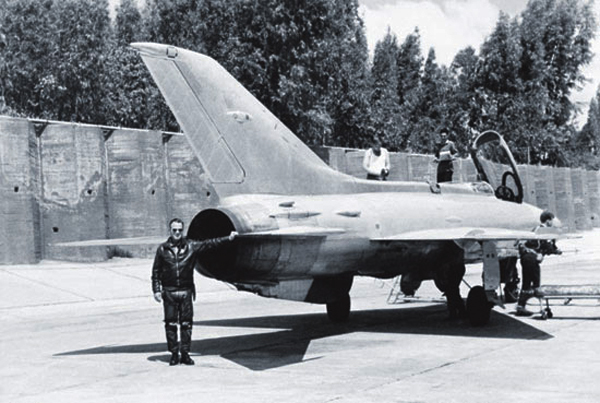
In late 1967 an Afghanistan pilot seeking political asylum fled to Israel in a Mig-21. A highly classified program was put together to evaluate the Mig's performance and stability characteristics and to determine the areas of the flight envelope in which the Mig enjoyed a tactical advantage or disadvantage when compared to U.S. fighter aircraft. This information was critical to the success of the air campaign then being waged in the skies over North Vietnam. Jordan was selected for this evaluation role because of his superior knowledge in flight-testing of tactical aircraft and evaluating their systems. He went to Israel to perform the initial evaluation on the Mig which was immediately used to modify combat tactics being used in Vietnam. As a direct result of Jordan's flight envelope evaluations in Israel, and in a continuing series of flight evaluations conducted after the Mig was transported to the United States, a classified training film "Project Have Doughnut" was produced. This film was used to train U.S. pilots in exploiting the Mig-21 vulnerabilities and directly lead to an enhanced combat victory ratio.

Monday, December 05, 2011

John D. Omvig 1923-1967


The first production F8U-2 ‎(BuNo 145546)‎ made its first flight on 29 August 1958 with Vought test pilot John Omvig at the controls.

Thursday, December 01, 2011

Peter Sedgwick


The BAe146 made its maiden flight from Hatfield on 3 September 1981. Piloted by Mike Goodfellow, BAe chief test pilot, the other crew members of G-SSSH were: Peter Sedgwick, deputy CTP; Roger de Mercado, chief flight development engineer and Roger Hammond, instrumentation engineer. The BAe 1000 made its maiden flight on 16th June 1990, lasting 2 hours 15 minutes, flown by Chief Test Pilot Peter Sedgwick and Project Test Pilot Goerge Ellis.


Thursday, November 17, 2011

Cecil Arthur Rea, A.F.C 1885-1975


Flight Lieutenant Cecil Arthur Rea, A.F.C., was born in Belfast in May 1885 and was employed on the Canadian Pacific Railway prior to joining the R.N.A.S. in late 1914. Rising rapidly to Chief Petty Officer in the Armoured Car Detachment, he was commissioned Flight Sub-Lieutenant in July 1915 and underwent his Pilot's Course at Eastchurch that October, his Service Record noting that among other achievements he completed some night flying. Further training at Hendon ensued, and during a return flight from Cranwell, Rea's machine, G.W. Box Kite No.3609, became inverted and crashed. No blame, however, was attributed to the Pilot who escaped unscathed. Advanced to Flight Lieutenant in October of the same year, he commenced his brief as an Experimental Pilot in July 1917 and had completed in excess of 150 hours on 'all types' by the middle of 1918 - pioneering work that resulted in a recommendation for his advancement to Flight Commander and, no doubt, largely contributed to the award of his A.F.C.Post-War, Rea, remaining in the regular R.A.F. until 1926, continued as a Test Pilot of Seaplanes, Amphibians and Aeroplanes. In 1924 he was granted special leave as one of two Pilots selected to fly the Gloucester Aircraft Company's Schneider Trophy entry, a Gloster Napier Seaplane, in the contest that year in the United States. Unfortunately, the other Pilot, Captain Broad, crashed the machine 'when alighting after its first flight' and, in Rea's words, 'performed some unrehearsed "hydrobatics" but escaped with a shaking' with the result that the 1924 British entry was scratched. On transfer to the Reserve in 1926, Rea joined Boulton & Paul Limited as Chief Test Pilot and the Company's Liaison Officer with the R.A.F. and Air Ministry. The following year he raised Boulton & Paul's profile by piloting one of their machines to win in the Tradesmen's Cup. In 1936 he was granted a five year extension of service in the Reserve, and the same year founded John Short Limited and established their aircraft works at Norwich. He resigned from the R.A.F. Reserve in 1938, and later in the year was appointed Operations Officer (Balloons) at the Air Ministry. In 1939 he moved to the Ministry of Aircraft Production, as Production Officer with responsibility for barrage balloon equipment. From 1940 to 1943 he was Senior Production Officer concerned with various aspects of balloons and aircraft, and between 1944-45 was Technical Officer at the 'German Document Centre'. At the conclusion of Rea's career as a Test Pilot he had flown a staggering total of 136 different types of aircraft.

Kingsley 'Peter' Henry Tisshaw 1923-1949


Kingsley Peter Henry Tisshaw was born at Putney on September 25th, 1923, and received his education at St. Paul s School and at Aberdeen University. He joined the R.A F in 1941 and, after training in the U.S.A., served as a flying instructor at a number of R.A.F. home stations. He married in 1945 and in December of that year was posted to Turkey, returning to this country in January, 1947. Two months later he left the R.A.F. and took his " B " Licence and Second
Navigator's Licence with Straight Aviation Training Ltd. before joining Boulton Paul in August, 1947. He was killed alongside BPA Chief Test Pilot Lindsay Neale in an accident to a prototype Balliol T.2 on February 3rd 1949. The aircraft was being flown from Wolverhampton Airport on one of a series of diving tests by Mr. Lindsay Neale, with Mr. Tisshaw acting as observer. After brief tests from some 14,000ft, the Balliol was seen to be descending at very high speed and crashed in a field about half a mile from the airport, both pilots being instantly killed. The cause of the accident was due to the canopy becoming detached.
Peter Tisshaw belonged to a generation of " up and coming " young test pilots, and his skill in flying and reliability of judgment had already commanded the respect of his colleagues.
Quiet in manner and very likeable in disposition, he was happiest when in the air.

ACdre George F.A Skelton 1909-1985


George Skelton joined Boulton Paul Aircraft as a test pilot in 1937,flying Defiant's and Rocs. He was recalled to the RAF in 1939 jonig No 264 Sqn, the first Defiant unit.


Taking off at 04.15 hrs o Monday 13th Ma 1940 from Martlesham along with 5 other Boulton Paul Defiant's and 6 Spitfires from 66 Squadron. F/Lt George Skelton and Air Gnr Jack Hafield were flying Defiant L6969. The object being to patrol the Dutch coast between Ijmuiden and the Hague to attack German troop transport.They flew across the North Sea, making landfall about ten miles north of The Hague at 0515, after which all aircraft turned north. Over IJmuiden they were fired on by Dutch anti-aircraft guns located on the south side of the harbour. The guns were firing accurately but they ceased fire immediately the British signalled the Dutch letter of the day. All aircraft turned about and flew south along the coast. More fire, this time German, was met over Maassluis which caused sections to take evasive action. Shortly after, the No. 66 Squadron Spitfires turned east towards Rotterdam where there were fires raging in various places while the Defiant's followed a more southerly route. Approaching Rotterdam, the crews of both flights saw about seven German Ju 87 Stukas (belonging to 12. Staffel of Lehrgeschwader 1) dive-bombing a target to the south-east. The Defiant's went in to the attack and a ferocious air battle developed. Shortly after, Bf 109's from 5. Staffel of Jagdgeschwader 26 joined the battle, which then developed into a series of individual dogfights. Hit by German fighters, the pilot of Blue 1, Flight Lieutenant George Skelton, lost consciousness and the aircraft went into a spiral dive. His gunner, Pilot Officer Jack Hatfield, tried in vain to contact his pilot and finally abandoned the plane.After Hatfield had left the aircraft by parachute, Skelton regained consciousness and, being wounded and possibly to low to bail out, tried to save himself by gliding down to a strip of reeds to break his impact. He made a perfect emergency landing at the edge of the Donge River south of the town of Geertruidenberg where the wrecked aircraft would remain for a considerable time. The seriously injured pilot was brought to the St Theresia Hospital at Raamsdonksveer, where Dr. Charles Lips treated him. Initially the hospital staff hid Skelton but eventually the Germans found him and he was transferred to Germany where he remained in various camp hospitals until, due to his injuries, he was eventually repatriated to Britain via Sweden in 1943.


Thanks to the treatment he received from German doctors, Skelton was later able to fly again. In late 1944, after France had been liberated, he spent some time in Cannes with his wife and family to speed up his recovery. He later carried out administrative and technical duties in the RAF and in 1945 he was promoted to Squadron Leader. Two years later he was further promoted to Wing Commander and, from December 1948 to December 1950, served as Air Attaché in Prague. In 1952, now a Group Captain, he took a course at No. 101 Flying Training School to maintain his flying skills and later took a further course at No. 215 Advanced Flying Training School at Finningly. In 1954 he was posted to 2nd Tactical Air Force in Germany and in April 1956 promoted to Air Commodore. In 1959 he was appointed Chief of Air Staff but he left the service on his retirement later that year and returned to the south of France with his wife. His health deteriorated in 1979 and he returned to England for treatment. He died in King Edward Hospital in London on October 18, 1985, aged 76

Wednesday, November 16, 2011

Douglas Webster 'Tommy' Lucke 1909-1972


Douglas Webster 'Tommy' Lucke was born in Mexico. He had a colourful career from the time
when, at the age of 20, he worked his passage from Texas to take an R.A.F. short-service
commission.
On completing it he joined Ethyl Export for flying duties which took him to many parts of the world. In 1937 he joined Bristols as an instructor, then re-entered the R.A.F. and was engaged on flying which included work in connection with countering the magnetic mine and the development of the Mohne Dam weapon and of airborne lifeboats. From 1946 to 1948 he was with B.O.A.C. as chief test pilot at Croydon. He was appointed C.F.I, to the Royal Egyptian
Air Force and served for a year before giving up active flying for health reasons. In 1954 he joined the Sales Department of Export Packing Service, Ltd., a large proportion of whose work consists of the preparation of aircraft and components for transportation.

Richard A.V. Hazlehurst 1922-1960

Richard Hazlehurst flew with Bomber Command during the war and won the DFC, joined Bristol Siddeley Engines as a test pilot in 1959. He had 7,800 flying hours on 30 different types of aircraft. He was killed in an accident at Filton to a Fairey Gannet along with two of the company's flight development technicians, P. Field and E. P. Potter.

Sunday, November 13, 2011

Barry Radley 1923-dec


After joining the R.A.F. in 1938, he became a night fighter pilot in No. 125 Sqn. during the war, and an R.A.F. test pilot in 1946. Was at E.T.P.S. in 1949 on No8 course, and at R.A.B. for 21 years. Flew with Sabena for six months before joining Hunting Percival in 1953. He became deputy chief test pilot of Hunting Aircraft and latterly joined IATA in Montreal until 1962 before sailing for South Africa in 1963 to join the Department of Transport in Pretoria as a senior inspector of flying. A member of the Society of Experimental Test Pilots, He had over 5,000hr flying on 140 different aircraft types.

George F. Thornton DFC


George F. Thornton DFC joined de Havilland Aircraft from the R.A.F. in 1949 as a production and development test pilot at Hatfield. He trained in the U.S. (1942-43) and flew Mustangs
and Spitfires with No. 2 Sqn., 2nd T.A.F. (1944-45). Was with No. 208 Sqn. in Palestine (1947)
then at the C.F.E., West Raynham, for his last two years of R.A.F. service.

Wednesday, November 02, 2011

James 'JB' E. Brown III 1954-


James Brown III was born in 1954 and grew up in Birmingham,Alabama. His interest in flying developed with help from his father, who was an amateur pilot. The young man dreamed of one day becoming an astronaut. He attended the Virginia Military Institute (VMI) in Lexington,Virginia and graduated in 1976 with a Bachelor's Degree in Civil engineering. Brown's first solo flight occurred in February 1976.

After graduating from VMI, Brown was commissioned as a 2nd Lt in the United States Air Force. He entered the Undergraduate Pilot Training program in 1977 and earned his wings the following year. Brown's first operational tour began in 1979 with the 480th Tactical Fighter Squadron of the 52nd Fighter Wing at Spangdahlem Air Base in Germany where he flew the F-4 Phantom II. On his next tour, Brown flew the F-5E Tiger II with the 527th Aggressor Squadron at RAF Alconbury in England.

He is the chief test pilot for the F-22 Raptor program and is stationed at Edwards AFB in California where he performs activities including avionics testing, flight envelope expansion, and the creation of procedural flight manuals for the Air Force. Previously, he was the chief test pilot for the F-117 Nighthawk. Brown is a Fellow and past president of SETP and is a Fellow of the RAes.


Monday, October 24, 2011

Graham T. Tomlinson 1950-


In 24 years with BAE Systems, Graham tested Hawks and Harriers at Dunsfold in Surrey before relocating to Fort Worth in Texas as the lead STOVL test pilot. He was a Harrier pilot with the Royal Air Force before joining BAE Systems. He was selected to fly the first STOVL aircraft, BF-1, and to be the lead test pilot for the STOVL flight test programme due to both BAE Systems’ and Graham’s personal STOVL experience


In 2010, Graham made the first vertical landing of the F-35B Joint Strike Fighter at Naval Air Station Patuxent River in Maryland.


He was presented with the prestigious Guild of Air Pilots and Air Navigators (GAPAN) Derry & Richards Memorial Medal, given in recognition of outstanding contributions in advancing the art and science of aviation.