Friday, December 28, 2007

Jack Scott 1908-2002


Born in May 1908 Jack Scott learned to fly in 1933 and up to the outbreak of war flew with a variety of organisations including Atlantic-Coast Air Services (His own airline), Imperial Airways and the private and charter firm Olley Air Services. He first made the news in 1939 when he landed a flight into Croydon from France on one wheel after an undercarriage failure, circling for ninety minutes to reduce his fuel load he demonstrated his talent by landing the aircraft with only minimal damage to the aircraft and no injury to himself or any of the passengers

At the outbreak of war he was called up as a squadron leader and posted to 24 squadron a communications unit. In 1941 he became chief flying instructor of 51 Operational Conversion Unit, teaching night-flying tactics and moved again in 1942 to the Beaufighter equipped 29 Squadron. Jack Scott's superb flying skills had always stood him out and in 1943 he was posted to Coventry to test-fly newly produced Mosquito's from the Standard Motors production line. He was at Coventry for a year before moving on to Rolls Royce at Derby where he did test and development flying on the new Merlin powered P51 Mustang.

1945 saw a move to Power Jets as its new chief test pilot a position he maintained when it became the National Gas Turbine establishment where he was involved in testing a number of jet engine systems including thrust-reversal and reheat. His association with the ejection seat began in July 1946 when he piloted Meteor EE416 with Bernie Lynch's on board for the first live ejection from a British Aircraft. He also flew the aircraft on later ejection tests at up to 500 mph and was the pilot when Sqn Ldr John Fifeld carried out the first runway level ejection from converted Meteor T7, WA634 at Chalgrove.

Jack Scott was a founder member of the British Airline Pilots Association, a member of the Royal Aeronautical Society and retired as chief test pilot of Martin-Baker in 1960. He was a pioneering test pilot at the dawn of the jet age and died age 93, in May 2002.

Wednesday, December 19, 2007

Thomas Don Lucey 1922-2004

Don Lucey joined the R.N.V.R in 1941 and served until 1946. After the war he went to ALbert Herbert Ltd then to Cambridge University,where he took a degree in mechanical sciences. He joined the Hawker Aircraft Company at Dunsfold in 1952 and became atest pilot the following year. He was Chief Production Test Pilot at Hawker,Blackpool between 1954-57 and then returned to Dunsfold.

S/Ldr William ' Bill ' A. Waterton GM AFC 1916-2006

Bill Waterton(right) discussing the flight with Prince Bernard of the Netherlands


Squadron Leader William Arthur ‘Bill’ Waterton was born in Camrose,Alberta in 1916. After two years at the Royal Military College of Canada, he went to Britain, took flying lessons and joined the Royal Air Force on June 10, 1939. Three months later, Canada declared war on Nazi Germany.Posted to No. 242 (Canadian) Squadron, he flew in the Battle of France until he suffered severe head injuries on May 25, 1940, when he crash landed his Hurricane fighter near Dover. While instructing pilot trainees in Canada in 1942, he was awarded the Air Force Cross for "acts of gallantry for fighting with the Royal Air Force."
He gained much of his extensive flying experience with the RAF's Air Fighting development unit. This was based at Wittering in Lincolnshire and had an important role in devising tactics for fighter command based on the actual performance of aircraft rather than what the manufactures claimed they were able to achieve. In 1946 he was posted to the Royal Air Force's High Speed Flight, a group that was determined to keep the world's speed record in Britain. On September 7, despite an attempt by Royal Aero Club officials to disqualify him because he was Canadian, he flew his Meteor EE550 at an average speed of 614mph. Group Capt Donaldson increased the world air speed record to 616mph. He was awarded a second Air Force Cross following the success of the team but left the RAF in October 1946 to join Gloster as a test pilot on the princely salary of £1,000 per year.

He became the chief test pilot for Gloster in April 1947 and was involved in all the experimental flying with the later models of the Meteor and in training of pilots for other air forces beginning with Argentina, the first export customer for the Meteor. In December 1949 he was sent to Canada on loan to Avro Canada to test fly the prototype Avro CF-100. The first fight of the CF-100 took place on 19th January 1950 with Bill Waterton at the controls. He remained on loan with Avro Canada until February 1951. Following his return he continued to be the primary experimental test pilot for Gloster including the first flight of the Javelin (WD804) in which he suffered his most serious crash following the loss of the Ailerons due to aerodynamic flutter. He was awarded the George Medal for his actions in returning to the burning wreckage to recover flight data, which would prove useful in resolving the cause of the crash, therefore saving thousands of pounds.

Bill Waterton resigned from Gloster's at the end of May 1954, He left after serious disagreements with the management of Gloster which are detailed in his comprehensive book "The Quick and the dead".
After leaving Gloster, Bill Waterton returned to Canada and became an aviation journalist.

Sqn Ldr Peter Scott

John G 'Johnnie' Towle 1927-2011


Flew with Airwork and Test Pilot with Glosters,Bristol Siddeley and Rolls Royce. Whilst at Glosters he was one of the Javelin production Test Pilot team,also ferrying meteors to overseas air forces. John Towle flew the maiden flight of the Afterburning Armstrong Siddeley Saphhire engined Gloster Javelin F.A.W.8 in 1958. He was part of the crew that flew the HS125 around 16 European countries in 1964 in a time of 19hrs 32mins.

Peter G Lawrence 1920-1953

Peter Godfrey Lawrence entered the aircraft industry in 1937 as a Handley Page apprentice, and in 1939 joined the Fleet Air Arm, serving in Swordfish squadrons from 1940-1942 and in the Naval Trials Unit, on test flying duties, until the end of the war.

He joined Blackburn Aircraft as an experimental test pilot in 1945 and, after taking No4 ETPS course, was appointed chief test pilot. His MBE was in recognition of his deck landing trials of the Firebrand 4. In June 1952 he left Brough in order to become an English Electric test pilot, and at the beginning of this year he transferred to Glosters, where he was involved in the experimental flying of the Gloster Javelin prototypes.

He was a great air-racing enthusiast, and from 1948 onwards flew such varied aircraft as Firebrands, Blackburn B.2 and a Proctor in the major events. He won the Kemsley Trophy last summer. He displayed aircraft at the SBAC shows at Radlett and Farnborough, giving a spectacular display with a Firebrand complete with torpedo, rolling it at low altitude. He had flown over 80 types of aircraft and ammaseed more than 3,000 flying hours.

He was killed on June 11th 1953 in a flying accident, whilst flying a prototype Javelin. In an attempt to avoid injury to people and damage to property on the ground, he stayed with the aircraft until 250feet before ejecting, unfortunately he was too low and was killed on impact with the ground.

E. Brian Smith 1923-1956


Brian Smith served with the RAF from 1942-1946,and was later in No 501 Sqn R.Aux.AF,flying Spitfires and Vampires. He joined the Gloster Aircraft Company as a Test Pilot in 1951,flying Meteors and Javelins.
He was killed following a mid-air collision in Augsut 1956. He was flying a Javelin from Moreton Valence when he was involved in a collision with an RAF Hunter. Mr Smith and his navigator F/L R.Jeffries ejected from the aircraft,but he failed to separate from his seat and was killed.

Mike Kilburn


Mike Kilburn was a production and development Test Pilot with Glosters ,mainly on Meteors,although he was still with Gloster for the early part of the GA5 and Javelin development. He was a very successful DH125 demo pilot in the US during the late 60's, early 70's, moving to DH Canada as Sales Executive.

Flt Lt. Peter W. Varley 1924-1989


Flt Lt Peter Varley joined the RAF in 1941 flying with No89 Sqn in Singapore.He left the service in 1947,but rejoined the following year with a permanent commision. He flew Hornets with No19 Sqn,took CFS course and was on No11 course at ETPS.

He joined Gloster Aircraft Company in 1955 as assistant to Chief Test Pilot Dicky Martin,who had been his commander when he was with Aero Flight at the Royal Aircraft Establishment,Farnborough. While serving at Boscombe Down,he took part in he 5 Javelin formation at Farnborough 1954 Air show. He joined Armstrong Whitworth and test flew the Argosy,demonstrating it at Farnborough in 1959.

Michael Morss 1928-


Michael Morss was a Javelin production Test Pilot who also feeried meteors to overseas air forces. He joined Glosters as a Test Pilot in 1955. Born in 1928 in Glasgow,he studied mechanical engineering at Glasgow University,where he also began flying with the Glasgow University Air Squadron. In 1950 he joined the RAF for 2 years National Service,and then went to Performance Division of A&AEE at Boscombe Down as a technician. He flew with 615 (County of Surrey) Squadron RAuxAF at Biggin Hill.

F/L Rodney Dryland DFC 1922-1949


Rodney Dryland attended Bablake School between 1933-1938. He did his flying training in Rhodesia in 1941. He did a year's ferrying aircraft in the Middle East before going to No3 Sqn in 1943. While with the Squadron Dryland shot down four aircraft and 21 flying bombs. He was the first pilot to destroy 5 flying bombs in one patrol. He was shot down in December 1944.

He joined the Gloster Aircraft Company in 1946,and was acting Chief Test Pilot at the time of his death as the result of a flying accident while testing a Meteor 4 at Moreton Valence on July 13th 1949.

Tuesday, December 18, 2007

S/Ldr Frederick John 'Jeep' Cable AFC 1915-1950


Frederick John Cable was a Ministry of Supply test pilot at A.F.E.E., Beaulieu, and his flying
career was probably unique in that he had never flown a fixed-wing aircraft.
Born in 1915, " Jeep " Cable, as he was always known, was taught to fly at the age of 16 by Alan
Marsh, and as soon as he could, at the age of 17, obtained his pilot's licence—for rotary-wing aircraft only. Thereafter, he joined the Cierva Company and became, in turn, a flying instructor, staying with the company as an engineer "and instructor until 1939, when he became engineer and pilot in charge of experimental flying with G. and J. Weir, Ltd. At the outbreak of war he went to Duxford as a civilian pilot, but was commissioned in the R.A.F. in 1941, finally becoming the Commanding Officer of the Research, Development and Training Unit for Rotary Wing Aircraft A.F.E.E., Beaulieu. He left the Service in August, 1947. and took up a civilian appointment with the Minister of Supply as chief helicopter test pilot at A.F.E.E.

He was killed on the 13th June 1950 along with Mr. H. A. Marsh and Mr. J. Unsworth. All three were involved in an accident,which occurred near Eastleigh, to the Cierva Air Horse when the rotor blade broke away.

S/Ldr Henry 'Harry' Alan Marsh AFC 1901-1950


Henry Alan Marsh, A.F.C., A.F.R.Ae.S., manager and chief test pilot of the Cierva Autogiro Co., Ltd., was recognized as the most experienced rotary-wing pilot in the world. Born in 1901, he served in the Royal Air Force from 1918 to 1930 and then became assistant instructor to the Hampshire Aero Glub, where he met Juan de la Cierva, and became interested in Autogiros. In 1932 he joined the staff of the Cierva Company, and became chief flying instructor at the Cierva Autogiro Flying School at Hanworth.

From 1933 onwards, Alan Marsh assisted Cierva with experimental flying, and also carried out the same duty for G. and J. Weir, until 1939, when he was recalled to the R.A.F. and was assigned to the experimental flying staff of the R.A.E. at Farnborough. In 1941 he took over No. 529 Squadron from W/C. Brie, the Squadron being equipped with Autogiros, and its duties being concerned chiefly with radar calibration. He left the Service in 1946 with the rank of squadron leader, and rejoined the Cierva Company,his post-war duties having been chiefly concerned with the experimental flying of the W.9, W.u and W.14 Cierva helicopters. He was killed on the 13th June 1950 along with Mr. F.J. Cable and Mr. J. Unsworth. All three were involved in an accident,which occurred near Eastleigh, to the Cierva Air Horse when the rotor blade broke away.

A member of the instructors' panel of examiners for the G.A.P.A.N., and
chairman of the Helicopter Association of Great Britain from 1946 to 1949.

Sqn Ldr James B. Starky DSO DFC 1916-1996


James Bayntun Starky was born in Gisborne,New Zealand on 10th November 1916. He joined the RNZAF on 2nd July 1940 and was posted to Operational Tarining Unit at Lossiemouth where he learned to fly Wellingtons. He was posted to 149 Sqn (wellington's) in Egypt. On his return to England in 1942 he became a Test Pilot on many aircraft including Spitfires,Mosquitoes and Beaufighters.

He returned to Operations in April 1943 with 115 Sqn (Lanacaster's) earning a DFC and DSO within 10 days of each other. He flew 47 sorties on Lancasters before serving briefly as a flying instructor before being posted to the ETPS at Boscombe Down as a member of No2 course,Mar1944-Mar1945. He was employed on test flying for the rest of 1945 at the Aircraft and Armament Experimental Establishment testing heavy bombers.

He was repatriated to New Zealand in 1946 but returned to the UK to join the RAF in 1947. He returned to Boscombe Down and flew the experimental Armstrong Siddeley Sapphire powered Canberra. In 1948,he was appointed assistant test pilot to Waldo Price-Owen at Armstrong Siddely Motors Ltd, testing new turboprop and turbojet engines. He became the engine company's Chief Test Pilot in 1951.

Sqn Ldr Waldo Price-Owen 1916-1969


Sqn Ldr Waldo Price-Owen was born at Betton Abbots near Shrewsbury on 28th February 1916. He was inspired to fly by the exploits of Hinkler, Kingsford-Smith, Mollison and other aviators of the time. In 1937 he enlisted in the RAF and was posted to Ansty for ab initio training on Avro Cadets,which took him only 2 months, he was commissioned and posted to Egypt to undergo his service training at Abu-Sueir. He was awarded his wings in February 1938, after flying on Hawker Hart’s.

He was posted to No8 (Bomber) Sqn at Aden, who were equipped with Vickers Vincents. While with that squadron he was on operations against insurgent tribes in Yemen and Hadhramaut in the south west corner of Arabia. He remained on that work until 1939,when he returned to Egypt and was posted to No33 (Fighter) Sqn and then to No112 (Fighter)Sqn which were equipped with Gloster Galdiators. He was stationed with the latter squadron at Helwan when war was declared in 1939.

In 1940 he joined No80Sqn to take part in the war in Greece,where he remained until April 1941. He then went to the Gold Coast as Convoy leader, ferrying new aircraft across Equatorial Africa to Cairo. Some of these were American aircraft, so when shortly after this he was sent to Port Sudan, he was able to begin his career as a test pilot, and was made Chief Test Pilot of the station that assembled American aircraft which arrived by sea. After three months he was sent to Eastleigh, Kenya, as Chief Test Pilot of the station, testing Mohawks and other American aircraft for the South African Airforce.

After tours at an Operational Training Unit back in the UK and a further tour in the Mediterranean area, came the turning point in his career, when he went for test flying in a big way. He went through No2 course at ETPS. During this time, he was attached to Fairey Aviation Co Ltd, whose test airfield was at Heathrow. He flew production Fireflies.

From January to March, 1945, he was attached to Westland Aircraft at Yeovil testing Seafires and Welkins under Harald Penrose. At his own request he was then posted to the Aircraft and Experimental Establishment at Boscombe Down and ws engaged on experimental flying on single and twin-engined aircraft. He was awarded the King’s commendation for his work and was given command of ‘A’ Squadron. During this time he also did a deck landing course on HMS Premier. This was his last appointment with the RAF.

In August 1947, he joined Armstrong-Siddeleys as Chief Test Pilots at Bitteswell,near Rugby. He was the first pilot to fly a single engine turboprop aircraft,when in 1948, he made the maiden flight of the Boulton Paul Balliol trainer, which was fitted with the Armstrong-Siddeley Mamba engine. In 1951 he left the aviation industry to pursue other interests.

He had flown over 2,000hours on more than 82 different types, including the Python-Wyvern, Lancaster with experimental Sapphire jet.

Michael Randrup 1913-1984


Michael Randrup was born on 20 April 1913 to Søren Revsgaard and Alexandra Randrup of Skive , Denmark. Michael Randrup's father is the Danish consul general in Shanghai , China , around 1920, but he travels to London , England , setting up an import-export business. Michael Randrup is educated at King's School, Canterbury , and Chelsea College of Aeronautics. On 22 May 1947 he becomes a naturalized British subject.

Early in WW2 he volunteered for the Royal Air Force, but information on his enlistment or details of his service other than the following are sparse.

On 4 September 1940 he was promoted to Pilot Officer on probation. On 4 September 1941 he was confirmed in this appointment and further promoted to Flying Officer. Exactly one year later on 4 September 1942 he was further promoted to Flight Lieutenant. Information suggests that he was posted to No. 234 (Madras Presidency) Squadron in September 1942.

In 1945 he was attached to the Royal Aircraft Establishment Engine Research Flight. While at RAE he was one of the pilots testing the Heinkel He 177A-5/R6 W. Nr. 550062 (re-serialled TS439) captured from the Germans in September 1944.

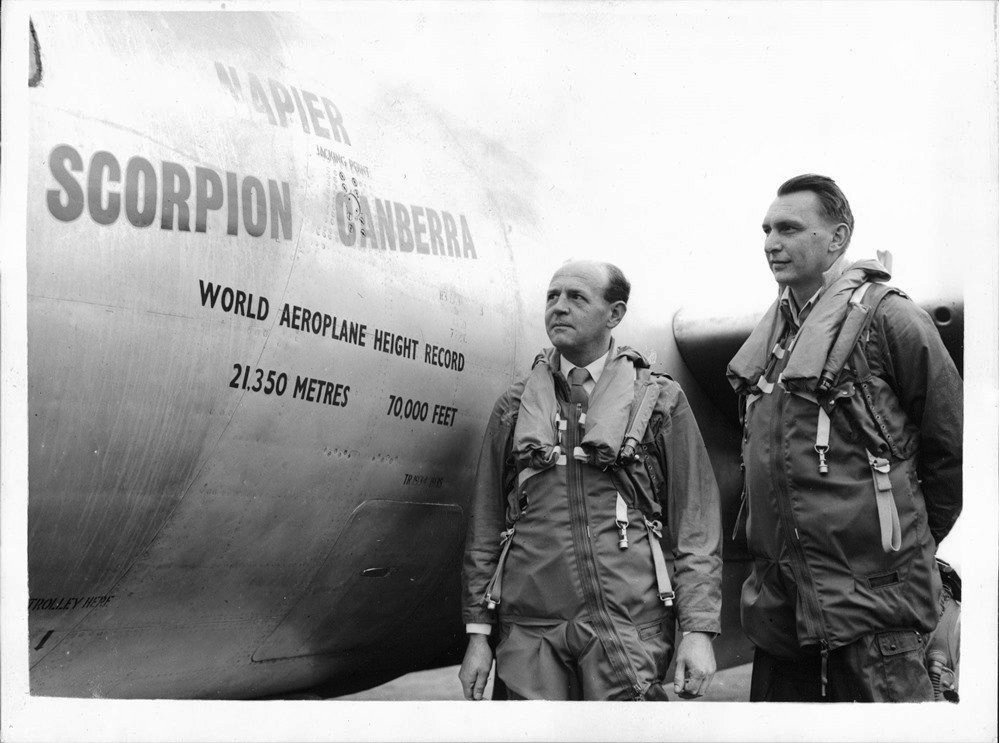
He became Chief Test Pilot for D. Napier & Son Ltd. in 1946 and remained so until 1960. On 28 August 1957 Michael Randrup piloted Canberra B.2 (WK 163) setting a new world aeroplane altitude record of 70,310 ft. The observer of the aircraft was Walter Shirley.

From 1966-1973 He was manager of the British Aircraft Corporation, Saudi Arabia.

Robin Lindsay Neale 1912-1949


Robin Lindsay Neale was born on the 24th January 1912 and educated at Caterham. His early business training was with the aviation department of Selfridges and with Brian Lewis and Co Ltd at Heston. He learnt to fly at Croydon in 1931 and,after a short period of association with Charmer,Gilbert Lodge and Co in 1935, set up his own aviation consultant's business in London,under the name Lindsay Neale Aviation Ltd of which he was managing director from 1935 until 1940. uring this period he was also a director and test pilot of Dart Aircraft Ltd.

On the outbreak of war he joined the RAF,from which he was released at the end of 1939 for test flying with Boulton Paul Aircraft Ltd,becoming their Chief Test Pilot in 1945.

He was killed along with Peter Tisshaw in an accident to the prototype Balliol T.2. The aircraft had climbed to 14,000ft for some tests. The windscreen disintegrated and the aircraft dived at high speed into the ground.

George B.S. Errington 1904-1966

All test pilots first came into the flying game primarily as young men with a terrific urge to fly, and only after having proved themselves to be of outstanding ability have they taken on the added responsibility of flight testing. Many of them started their flying careers as short-service officers in the R.A.F. George Errington thought differently. He decided that the only proper way to learn to fly was by becoming an aeronautical engineer first and by going through the shops and making aircraft. This decision, which he carried through despite many temptations to learn the easy way, has stood him in good stead. He holds ground engineers' licences A, B, C, D and X, all of which are still current. George's first contact with flying came whilst he was at Hamilton House Prep. School at Bath in 1913. As a small, but very interested, boy he helped a man who was experimenting with a glider on the hills round Bath. Launching was achieved by running downhill, and Errington well remembers the look of horror which came into the pilot's face when he made the suggestion that payment for help given might be in the form of a flight taken sitting on the pilot's shoulders! After leaving school—Uppingham —he studied at Sheffield University and was a pupil at Vickers' steel works to do the job thoroughly. He joined the Lancashire Aero Club and apprenticed himself to Avros. Woodford Airfield was, in those days, a smallish field with two ponds and one tiny hangar, and the only aircraft available was the original Moth presented to the club by Sir William Letts. His instructor was " Gas Pipe " Hall, and Johnnie Cantrell sent him solo. In the factory he helped to build Avro 504s and Avro Fives, and it is interesting to note that, whilst he never flew a 504, he did build the last one ever to be made—in 1930. The original Avro 504 first flew in 1912 and was the Tiger Moth of the 1914-18 war. Finishing up at Avros on the materials testing staff, and having obtained his licences and pilot's ticket, he went to the Comper Aircraft. Company (now Heston Aircraft) at Hooton as an inspector. This entailed both 'building and flying the Comper Swift. Meanwhile he managed to find time to run his own business as an electrical engineer. Here he became a private owner—or near owner. A gentleman by the name of Hart gave him free use of an Avro Avian, and Errington used that Avian as no other privately owned machine has ever been used. Much of his electrical engineering dealt with installations in private houses, and George flew the Avian from field to field to save travelling time. When Compers moved to Heston he decided to build his own aircraft. He bought a crashed Swift and completely rebuilt it. He first flew it in August, 1934. It was whilst at Heston that he first saw an Airspeed Courier. This had a retractable undercarriage—a very wonderful thing in 1934—and George thought, "Here is an advanced firm," so he promptly went down to Portsmouth and got a job as an inspector with Airspeeds. In 1935 an occasion arose when there was an aircraft to be tested (a Wolseley-engined Envoy) and no pilot avail-able. He test-flew it, and his report was so comprehensive that he was offered the job of test pilot. His total flying time at that period was in the region of 400 hours. George's first really big job came in 1936, when he had to fly a military Envoy out to South Africa, and to erect and test-fly the remainder of the contract out there. Whilst he was there the England-South Africa race took place, and Errington flew a Puss Moth to investigate the Max Findlay Envoy crash near Abercorn. Unfortunately he got lost and, running out of juice, made a forced landing at Mpika in the territory of the Wanyika tribe. The landing was made at 6,000ft with two yards to spare at the end of the run. The area was very remote, and the natives, having never seen an aircraft before, decided that George was a god. For a long while they would not go near him, and as nightfall came they went away and left him with only his blind-flying instruments as company. Anyone in the same predicament has Errington's assurance that the only way to sleep in a Puss" Moth is by tying one's head up to the cockpit roof! The next day a native arrived who had had slight contact with white men. He was dressed in a very long nightshirt and had an extra long grey beard so George mentally nicknamed him St. Paul and spent a long time making him understand that even God couldn't eat bantam's eggs raw, and getting him to take a message to the nearest white man. Eventually the local District Commissioner arrived with a thermos of tea—which was a change from water caught in a waterproof map as it ran off the trailing edge of the wing. The District Commissioner produced four gallons of petrol which enabled Errington to get the Puss Moth off down a 250-yard clearing (his wheels went through the trees at the end) and to fly to an Imperial Airways emergency landing ground to fill up. His next long trip was to deliver an Envoy by air to General Pakhoi, at Liuchow, in Kwangsi Province, China. The start was complicated by the non-arrival of payment.plus the proximity of the monsoon period. The financial side having been settled, Errington started on his 9,000- mile trip and ran slap into the worst of the monsoon weather. Between Calcutta and Akyab 15 inches of rain fell in 9 hours and whilst he was flying in this area all the instruments on the dashboard filled with water. Each day, after flying was finished, he did his own aircraft and engine maintenance, and so strenuous proved the flight that he lost more than i61b on the journey. The last 350 miles had to be flown by dead reckoning—much to the consternation of a Chinese pilot whom George was giving a lift to Linchow ; he considered that the slide-rule must be in the nature of a joss stick to be able to bring an aircraft dead over the airfield from above the clouds. The first real prototype Errington flew was the Airspeed Oxford, and the first flight in that was made by F/Lt Coleman. The same applies to the Queen Wasp, which was one of the early radio-controlled target aircraft. The Oxford was the first medium-weight twin-engined aircraft ever to do complete spinning trials. George found it was so stable in the spin that he was able to take an ordinary camera and photograph the instruments during the evolution. After testing the A.S.39 (a four-engined fleet -spotter) and the A.S.45 (a single-engined trainer), the Horsa glider had to be put through its paces. This Errington considered to be little short of penance. For every flight—the maximum duration of which cannot exceed ten minutes—a tug aircraft and tow-rope has to be found, and then follows a combined take-off and climb*to height. Every landing is a forced landing ; the tow-rope has to be recovered and the glider towed back by tractor. Then the performance is started all over again. It was whilst doing diving tests on the Horsa that Errington had one or two very close shaves. On one occasion he felt a jerk, and a loud bang was heard immediately after dropping the undercarriage. The observer went back through the cabin but reported no damage, so the diving trials proceeded. Actually the undercarriage had hit the fuselage near the tail, and had knocked a great hole in the structure and broken a longeron. Why the tail stayed on during maximum-speed diving tests is difficult to understand, ft is said that an A.I.D. inspector, seeing it all happen, ran and picked up some of the wreckage and then fainted. As George became more adept at handling the Horsa, it was found that much time could be saved by releasing from the tug at 2,oooft, diving to a maximum speed of 230 m.p.h. and landing from the pull-out. His worst prolonged experience on a Horsa, however, came when the tug pilot got lost in low cloud, with the glider fully loaded. The tug—a Whitley—was able to climb but very slowly, and Errington had no experience at blind towing. To use one of his own expressions, " It is one of those pastimes requiring a good deal of gin and enthusiasm." The inevitable cavorting about in the slipstream followed. George was quite convinced that the tug pilot did at least three badly executed slow rolls, whilst he in turn decided that George had left the controls entirely and gone aft for another purpose altogether. Finally, they broke cloud very much in the ultra-low-tow position, having been very fortunate not to have got into serious trouble. Another aerial barge-towing moment occurred when Errington was trying out a designer's idea for introducing The next day a native arrived who had had slight aileron anti reflex. The result was a complete aerodynamic seizing-up of the ailerons on take-off. After breaking the back of his seat whilst trying to control the rolls by rudder alone, he let go and made a spectacular arrival over two haystacks as he landed at Netheravon. As he says, " an aircraft without any ailerons never fails to produce a hearty laugh from the spectators." On yet another Horsa occasion, when one undercarriage leg fell off and the other wouldn't jettison, his observers had great fun throwing out three tons of concrete blocks. The one-wheel landing he brought off after this scarcely scratched the paint. Altogether Errington seems to have had somewhat of a dog's life at this towing business. He has tried being towed in a fighter by a bomber on research trials of bomber - towing-fighter to combat areas, and he, together with Geoffrey Tyson, carried out successful flight refuelling tests under black-out conditions at night. His very nearest go happened way back in 1939 when he was putting a special twin ruddered Oxford through its spinning tests. The case was full load with e.g. extended aft. Errington put the Oxford into a spin at i6,oooft, checked at 12,000ft, continued out of control to 5,000ft, and then pulled the anti-spin chute cord. At first this did not appear to work, and another 1,000ft was lost; then the chute operated By now i« dense cloud at about 3,oooft Errington found that he could not jettison the anti-spin chute which had just straightened him up. This, however, broke away just as he came through the clouds, and a multiple g pull-out just enabled him to skim over the Devon hills below. In addition to the big job he did getting Horsa ready for the invasions, he also did a spell of flight testing on Spitfires and Mosquitoes. George Errington, A.F.R.Ae.S., has a total of 4,100 flying hours on 104 different types, including 11 gliders and two jets. He got his C certificate after five hours. He made the first flights of the Airspeed AS.30 Queen Wasp (K8887); AS.39 Fleet Shadower (N1323); AS.45 Cambridge (T2249); AS.51 Horsa (DG597) and the AS.57 Ambassador (G-AGUA). He was killed in a crash of an HS Trident 1C (G-ARPY)during a pre-delivery test flight for BEA near Felthorpe, north of Norwich, at about 1930hr on June 3 1966

Monday, December 17, 2007

Robert 'Robin' E.M.B. Milne AFC 1899-1976

Robin Milne climbing into an Airspeed Oxford in 1947.


Robin Milne flying the Airspeed Ambassador

Robin Milne in familar surrounding,flying one of the more than 2000 Airspeed Oxfords he test flew.


Robin Milne was born on the 23 January 1899 at Cannington Manor, Manitoba,Canada. His first encounter with flying came as an 11year old schoolboy, when he watched a display at his school’s sportsday.
Robin Milne joined the Royal Canadians (Lord Strathcona’s Horse) and came to England with his Regiment in 1916. His unit was stationed next to the Air Gunnery School in Hythe,Kent where he used to watch the aircraft, as a break away from the horses. He put in for and was granted a transfer to the Royal Flying Corps,and was posted to No43 Training Depot Station for flight training on Maurice Farman Shorthorns and Avro 504K’s.
After graduating in 1917, he was posted for a course at the School of Special Flying. He emerged with his Instructor’s Ticket (Category A.I) having a total of less than 14hours total flying in his logbook!. He was initially posted to TDS and then No1 Fighting School at Turnberry, however, keen to see action, he applied for and was posted to No28 Sqn during September 1918 at their base in Italy. He flew only a handful of fighter patrols and escorts in his Sopwith Pup before the armistice in November 1918.
On his return to England he put in another spell of instructing before being posted to Leuchars, where the newly formed RAF was looking for Camel pilots for ‘flying off’ trials from HMS Furious. After completing the trials he went to Copenhagen to join HMS Furious before transferring the HMS Vindictive for service in the Baltic in the Russian campaign fighting the Bolsheviks, he was there for 11months.
During this time he flew several patrols and was shot down by a Russian Cruiser, narrowly cheating death when he crash landed in a bog. He was taken prisoner and held in a little hut with a solitary guard. The ‘family’ version is that he waited for the guard to get drunk then nabbed his skis to freedom, athough Robin Milne was an extremely fit & motivated man, maybe something less fortunate happened to the guard!. He was mentioned in despatches for his service in the Baltic.
After a good spell of leave, Robin Milne was given a short service commission and posted as an instructor on the first course at Cranwell College. He was given a second A.I rating and was there for the next 5 years (he trained three R.M Groves memorial prize winners including H.Waghorn,winner of the 1929 Schneider Trophy race). He was granted a permanent commission in 1923 and posted to Katachi Depot in India as a Test Pilot where he spent the next 5 years. He returned to England in 1930 and left the RAF in 1931.
After a break of over a year from flying, Robin Milne joined the National Flying Service as an instructor at their Reading Club. When this was taken over by Phillips and Powis, which then became Miles Aircraft Ltd, he was appointed Chief Pilot for testing and Instructing.
His first prototype was the Cirrus Hawk, he also did most of the development flying on all the other Miles built aircraft. He left in 1936 to join Aircraft Distributors Ltd, then to 46 EFTS at Portsmouth as Deputy Chief Flying Instructor.
On the outbreak of WW2 in 1939 he was recalled to the Colours and posted to A.ST. He was released for special duty and joined Airspeed as a Test Pilot. The major part of his work at Airspeed was production testing of the Oxford, and by the end of the war he had tested over 2000 Oxford’s.(An incident recorded in his log-book with the Oxford turret blowing off, “ took off as Mk2, landed as Mk 1 ”).
In addition to this, he did development testing on the Horsa Glider, Consul. He also flew the DH Mosquito and Beaufighter and post war the Ambassador. When flying from Portsmouth, one of Robin’s lesser jobs (or hobbies perhaps) was roughly counting the bomb craters in the harbour mud courtesy of the Luftwaffe – Chichester Harbour was used as a lit decoy away from Portsmouth. He regularly flew mock ‘dog-fights’ with Ron Clear over Langstone Harbour – was doing so one day when a Director turned up on the ground. “ What the hell are they doing ?” “ Err,,,checks, Sir !” “ Yes, a cheque for a few thousand if they hit each other !”
After Airspeed were taken over, he ended up flying with DeHavilland, on the Dove & Comet.
Not many people can have graduated from flying Sopwith Camels to DH Comets, with very important war work in between!. He amassed more than 10,000 hours on more than 100 types of aircraft. He was a keen mountaineer when not flying, and climbed the Eiger.

Saturday, December 15, 2007

Dennis Tayler 1915-2006


Dennis Tayler learned to fly after joining RAF in 1939 and made over 100 operational sorties with Nos 50 and 139(Pathfinder)Sqns,in Mosquitos.

Posted to RAE Farnborough in July 1945 to fly German aircraft back to England; subsequently joined the establishment's Experimental Flying Department. Flew with the Radio and Aerodynamic Flights, where he flew the AW 52, FD.l and FD.2, Avro 707,deflected jet Meteor, SB.5 and SC.l research aircraft,among others. Chief test pilot of Short Brothers
and Harland since 1961 when he joined from RAE Farnborough. Made first flights of both the
Skyvan and Belfast freighters.

John Lankester Parker OBE FRAeS 1886-1965


John Lankester Parker OBE FRAeS Hon. was Chief Test Pilot for Short Brothers from 1918 until his retirement in 1945. He joined Shorts in 1916 as a part-time test pilot and assistant to then Chief Test Pilot Ronald Kemp, having been recommended for the post by Captain, later Admiral Sir, Murray Sueter,RNAS. By the time he retired he was a director of the company.

He gained his first flying experience as a pilot flying for the Northern Aircraft Company based in Windermere, where he worked between 1914 and 1916. It was during his time flying with the Northern Aircraft Company that he made the acquaintance of Murray Sueter, Ronald Kemp and Oscar Gnosspelius, all of whom would figure later in his work at Shorts. In 1916 he joined the Prodger-Issacs Syndicate of freelance test pilots, working for several British aircraft manufacturers.

His first assignment with Shorts began on 17 October 1916, when he was asked by Horace Short to test fly a batch of six Short Bombers from the Eastchurch airfield. In spite of his relative youth, his flying skills impressed Horace Short, who soon offered him a permanent position as assistant to Ronald Kemp.
He became Chief Test Pilot for Short Brothers in 1918 as successor to Ronald Kemp. Between 1918 and his last official flight as Chief Test Pilot on 22 August 1945 he flew every Shorts prototype on its maiden flight, ranging from the diminutive Short Shirl to the very large Short Shetland . During the course of his long association with the company, especially during the early pioneering years, he survived numerous forced landings, both on land and on water. In 1943 he became a Director of Short Brothers and Harland Ltd., Belfast.

Donald Burn Wright 1930-2005


Between 1944-46 he was a Cadet at HMS Worcester Royal Naval Reserve and between 1946-53 he was with Merchant Navy as a Cadet then followed as 4th & 3rd Mate (Navigating Officer) in Blue Star Line, 3rd & 2nd Mate (Officer) of Athel Line oil tanker.
In 1953 he joined the RAF as aircrew with pilot training in Canada (RCAF) and in 1954 he was posted to Bomber Command, joining No 115 Squadron RAF Marham flying Canberras. In 1956 the Squadron detached to Cyprus (Nicosia) for Operation Musketeer, the invasion of Suez. In 1957 he was posted to Little Rissington for flying instructor training prior to posting to Swinderby as instructor on Vampires later on Meteors. In 1960 he went on No 19 Course, Empire Test Pilots' School, Farnborough. In 1961 he was posted to Royal Aircraft Establishment Farnborough test flying various RAE ideas and problems associated with Structures and Mechanical Engineering,
using aircraft types from Hunter, Canberra and Javelin, to Beverley, Hastings and Lincoln. In 1964 he left the RAF to join Short Bros as Senior Experimental Test Pilot and was later the project pilot for the development and flight testing of Skyvan, and later of the SD3-30, commuter turbo-prop aircraft, on which he undertook maiden flight on 22 August 1974 Also, development test flying on the Belfast freighter, auto-land and 3-engine ferry flight performance
In 1969 he was appointed Chief Test Pilot in succession to Denis Tayler.
1976-79 Retired from Short Bros in 1976 to become Personal Pilot to HRH Prince Mohammed Bin Faisal Al Saud flying an executive HS125 and later a BAC 111 based in Jeddah, Saudi Arabia.
1979-90 He returned to UK to join Air Europe, a new holiday charter company, as a Captain and Training Captain flying the Boeing 737, until retiring at the age of 60 he then joined Channel Express as Captain flying part-time on freight and the night mail flying the Handley Page Herald.

'Jock' James Webster Still 1920-2012


James Webster ("Jock") Still, the son of a Master Shipwright, was born in Edinburgh on the 14th September 1920. He gained a bursary to study at Boroughmuir School, Edinburgh, where he achieved his Higher Learning Certificate. He applied for Pilot training and joined the R.A.F. in 1940, gaining his wings and the rank of Sergeant.

During the following six years he served as a fighter pilot in Britain, North-West Europe, the Middle East and Burma. Flying Spitfires, he took part in "train-busting" raids over occupied Europe and, when serving with No. 1 Sqn., shared in the defence of the country against flying - bomb attacks.

In late 1942 he became a Flight Sergeant and in mid 1943 was promoted to Warrant Officer Class 1. His first full ‘tour’ was with 41sqn at Tangmere and Westhampnett flying Spitfire Mk XII’s carrying out mainly escort duties to bombers of varying types over targets in France. The Squadron also undertook ‘Rhubarbs’ which were low level attacks (usually in pairs) seeking out ground targets such as train movements. His status as W/O only lasted a few months before he was commissioned in October 1943 as Pilot Officer, then becoming Flying officer whilst with No.41 Sqn at Tangmere.

After this tour he was posted back to his previous non-operational post as instructor at a Technical Exercise Unit at Grangemouth. He was then sent to Hucknall airfield for a short course on test flying (which included talks given by Geoffrey Quill and Nigel deHavilland). For the next 4 months he tested almost exclusively Spitfires and Hurricanes of varying marks.
He was next posted to an A.S.D.U at Millfield where he commanded a flight of Spitfires doing simulated bombing (with camera) on dummy targets – all of which was being guided by ground control operators reading Radar screens from vehicles.
In July 1944, from this posting he was again posted to No.1 Tactical Exercise unit at Kinnell where the flight made rocket propelled attacks on the range at Barry Links with Hurricane Mk IV’s followed by a posting to Eshott airfield as a test pilot on Spitfires. He expected to be there for some months but an emergency blew up and he was rushed down South to join the famous No1 Sqn at Detling, Kent. The work was to fly ‘doodle-bugging’ missions against the V.1 flying bombs, but this role changed to flying Bomber escorts after the V.1 launch sites had been overrun by the Allied armies advancing through France. He was promoted to Flight Lieutenant whilst with No.1 Sqn and remained at that rank until VE day by which time he was also a Flight Commander.

Just after VE day he was selected to go to the Far East (via India and Burma) where he was put forward for a Squadron Leader post. However this changed as during the 4 week transit to Bombay aboard a troopship the war with Japan ended. Travelling from Bombay to Poona and Bhopal he flight tested several ‘unserviceable’ planes and was made Squadron Leader (acting). His final posting was to Madras as Wing Commander (acting) where he was on admin duties with no flying until his demob back to the UK.

After the war he was a member of No. 603 (City of Edinburgh) Sqn.,RAuxAF. at Turnhouse flying Meteors and Vampires. During the Korean War, the Sqn went to RAF Leuchars where they worked up in preparation for deployment to Korea, however, hostilities ended before they were posted.

He joined Brooklands Aviation as a test pilot in 1950.

In 1952 he went to English Electric in the capacity of production test pilot on Canberra’s, testing various marks of Canberra He visited Venezuela in 1953 when that country bought Canberra’s seeing them into service and training their pilots. He demonstrated the Canberra B.8 at the Farnborough displays of 1954 and 1955.
Of interest, English Electric were contacted by the Mod and asked if they could assist them by performing a flight for them with the Canberra at their convenience. This flight was made by Jock Still after a test flight and involved taking the aircraft across the North Sea towards Denmark and then rapidly climbing to an altitude in excess of 40,000ft and then returning to the UK. The Mod called EE to ask when they would do the test to be advised that they had done it!. The aircraft had not been detected and the powers that be did not believe the flight had taken place (subsequently Jock discovered that this was to test the ground based radars against the threat of Soviet aircraft attacks). Another flight was arranged to be undertaken with an RAF pilot and was duly completed with the same result, they had not been detected. At least 4 Reconnaissance flights were made over Soviet territory by RAF Canberra’s around this time, it’s quite possible that this flight was made after it was recognised that the Soviets would have the same trouble detecting the aircraft as the RAF had done.

He joined the staff of Handley Page as a test pilot in 1955, where he was allotted the flutter test programme on the 2nd Victor prototype (WB775), which had been equipped with eccentric excitation devices in the rear fuselage. Right from the original design studies for the Victor, flutter had been recognised as one of the most crucial and difficult areas. Godfrey Lee (the designer of the wing and tail unit of the Victor) said ‘the test flights were outstandingly and courageously done, and I consider that the crew, Jock Still, the pilot and Frank Haye and Jock Ogilvy, the observers, deserve great credit for this work’. He displayed the Victor B.1 at the 1956 Farnborough display.

During his years of flying Jock Still has completed 3,150 hours on fifty plus types, he retired from flying in 1957 after a serious flying accident in a Victor.
He followed his successful and varied flying career with a successful business career in the Steel Industry and finally with BAC (British Aerospace Corporation) in Saudi Arabia overseeing the Saudi AF Lightning maintenance contract.